Wait! Don't Leave without speaking to one of our mortgage experts today!
Call us at 1-416-969-8130
Start with the purchase price, then build a cash-to-close estimate around location, property type, lender requirements, and rebate eligibility.
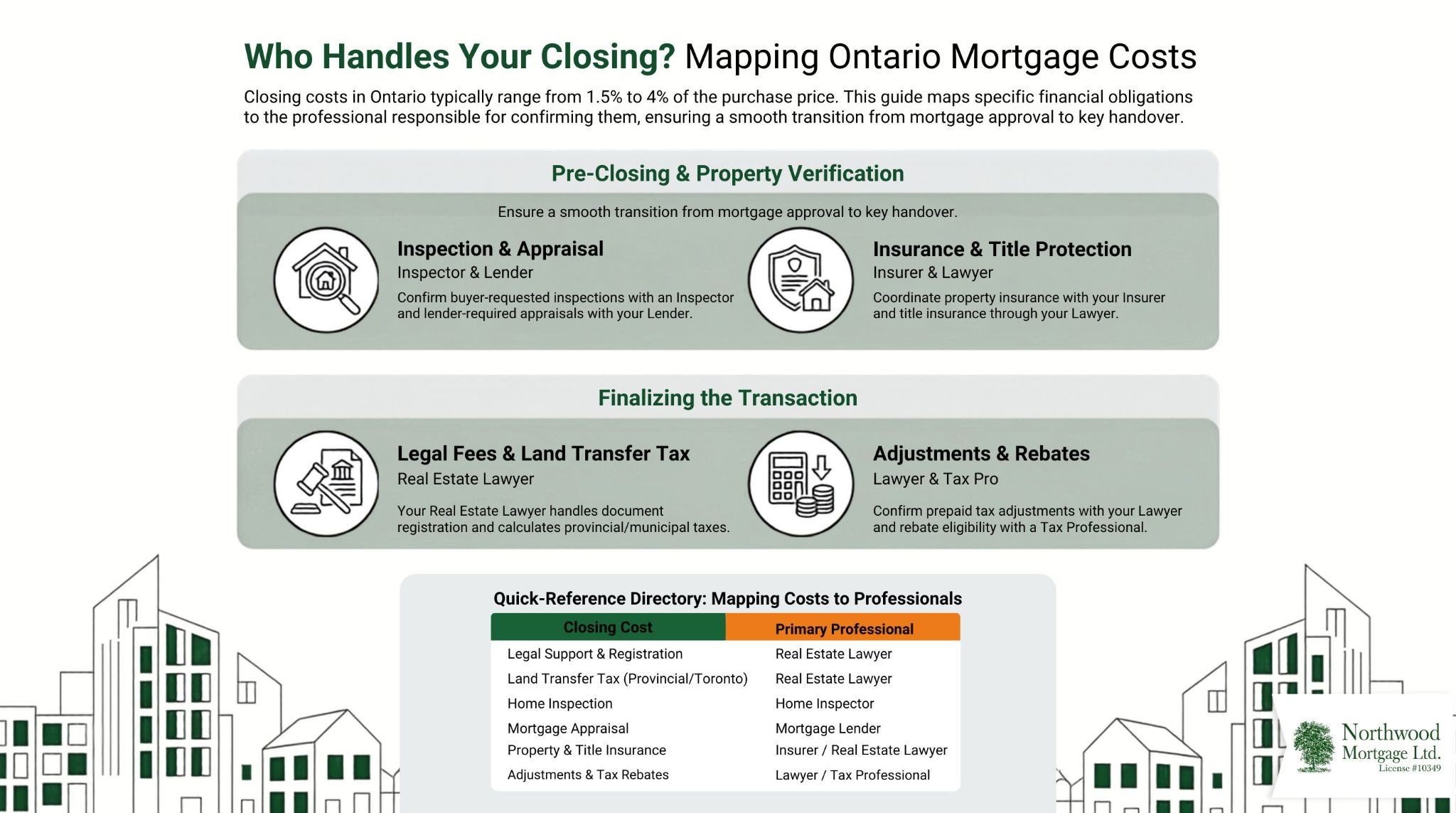
As a national guideline, buyers should be prepared to spend between 1.5% and 4% of the home’s purchase price on upfront or closing costs. In Ontario, land transfer tax, Toronto municipal land transfer tax, legal fees, title insurance, adjustments, property insurance, and lender requirements shape the final amount.
On an $800,000 Ontario purchase, the 1.5% to 4% guideline points to roughly $12,000 to $32,000 before the estimate is refined. Outside Toronto, buyers should check the estimate against provincial land transfer tax, legal fees, title insurance, adjustments, property insurance, and any appraisal the lender requires.
For a Toronto purchase, buyers should calculate municipal land transfer tax separately, then confirm whether a first-time buyer rebate or non-resident tax affects the cash-to-close amount.
Key factors that change the estimate include:
Several costs are confirmed late in the process, which can surprise buyers. Adjustments, final legal amounts, appraisal requirements, and prepaid tax or condo fee reimbursements may become clear only as the purchase gets closer to closing.
Use this table to separate legal closing costs from related cash needs that come up before, on, or shortly after closing:
| Cost | When It Applies | Confirm With |
|---|---|---|
| Legal support and registration | Purchase documents, title search, fund handling, registration, and closing coordination | Real estate lawyer |
| Land transfer tax | Based on purchase price and location, including Toronto municipal land transfer tax for Toronto purchases | Lawyer or land transfer tax calculator |
| Inspection and appraisal | A home inspection is buyer-requested. If the lender requires an appraisal, ask when it must be paid and whether it is collected before approval or later. | Inspector or lender |
| Insurance and title protection | Property insurance is usually required before mortgage funding. Title insurance is commonly arranged through the lawyer and may be required or recommended. | Insurer, lawyer, or lender |
| Adjustments and move-in costs | Reimbursements for prepaid taxes, utilities, or condo fees, plus service setup, repairs, and moving costs. These are not all legal closing costs, but they draw from the same cash reserve. | Lawyer, seller, or service provider |
| Rebates or non-resident taxes | First-time buyer rebates can reduce land transfer tax when eligibility rules are met. Non-resident speculation taxes may also apply to some foreign buyers, including Toronto’s municipal non-resident speculation tax on qualifying purchases. | Lawyer, provincial or municipal source, or qualified tax professional |
Move-in expenses are listed here because they affect the same cash reserve, even when they are not legal closing costs. Separating legal closing costs from move-in needs helps buyers avoid committing too much available cash to the down payment.
Land transfer tax is often one of the largest closing costs, especially in Toronto or on higher-priced homes. Because it is tied to purchase price, it can rise quickly and should be estimated separately from legal fees, title insurance, property insurance, adjustments, and moving costs.
Buyers can use Northwood Mortgage’s closing cost calculator or land transfer tax calculator for an estimate, then confirm final numbers with their lawyer or discuss the estimate with a Northwood Mortgage broker. For official tax details, review the Ontario land transfer tax guidance.
Ontario land transfer tax is calculated in brackets, with rates that increase as the purchase price rises. Ontario also applies a 2.5% rate to amounts above $2 million where the land contains one or two single-family residences.
Toronto applies a municipal land transfer tax in addition to provincial land transfer tax. As of April 2026, Toronto’s revised graduated municipal rates apply to high-value residential properties containing one or two single-family residences, so buyers should calculate the municipal amount separately instead of relying on the provincial tax alone.
Eligible first-time buyers may qualify for land transfer tax relief, but rebates depend on rules such as age, principal residence occupancy, citizenship or permanent resident status, and previous ownership by the buyer or spouse.
Rebate timing can also affect cash-to-close planning. Some eligible buyers receive the rebate at registration, while others may need to apply after closing.
Before assuming a rebate will reduce closing funds, buyers should confirm eligibility, documentation, ownership structure, occupancy requirements, and deadlines with a lawyer. High-ratio buyers should also ask whether provincial sales tax on mortgage loan insurance applies, since that tax may need to be paid separately rather than added to the mortgage.
First-time buyers often focus on the down payment and monthly mortgage payment, but the biggest budgeting problems often come from timing. The deposit, inspection, appraisal, legal fees, land transfer tax, and move-in expenses do not all arrive at the same point in the purchase.
That timing matters because mortgage approval does not automatically mean the buyer has enough cash available. A buyer may qualify for the mortgage but still run short if too much money is committed to the down payment before inspection costs, appraisal requirements, adjustments, insurance, and move-in needs are accounted for.
Before making an offer, first-time buyers should separate their budget into four buckets: deposit, remaining down payment, legal closing costs, and cash needed shortly after move-in. This helps them ask their broker, lender, and lawyer more precise questions about what is due now, what is due at closing, and what should stay available after possession.
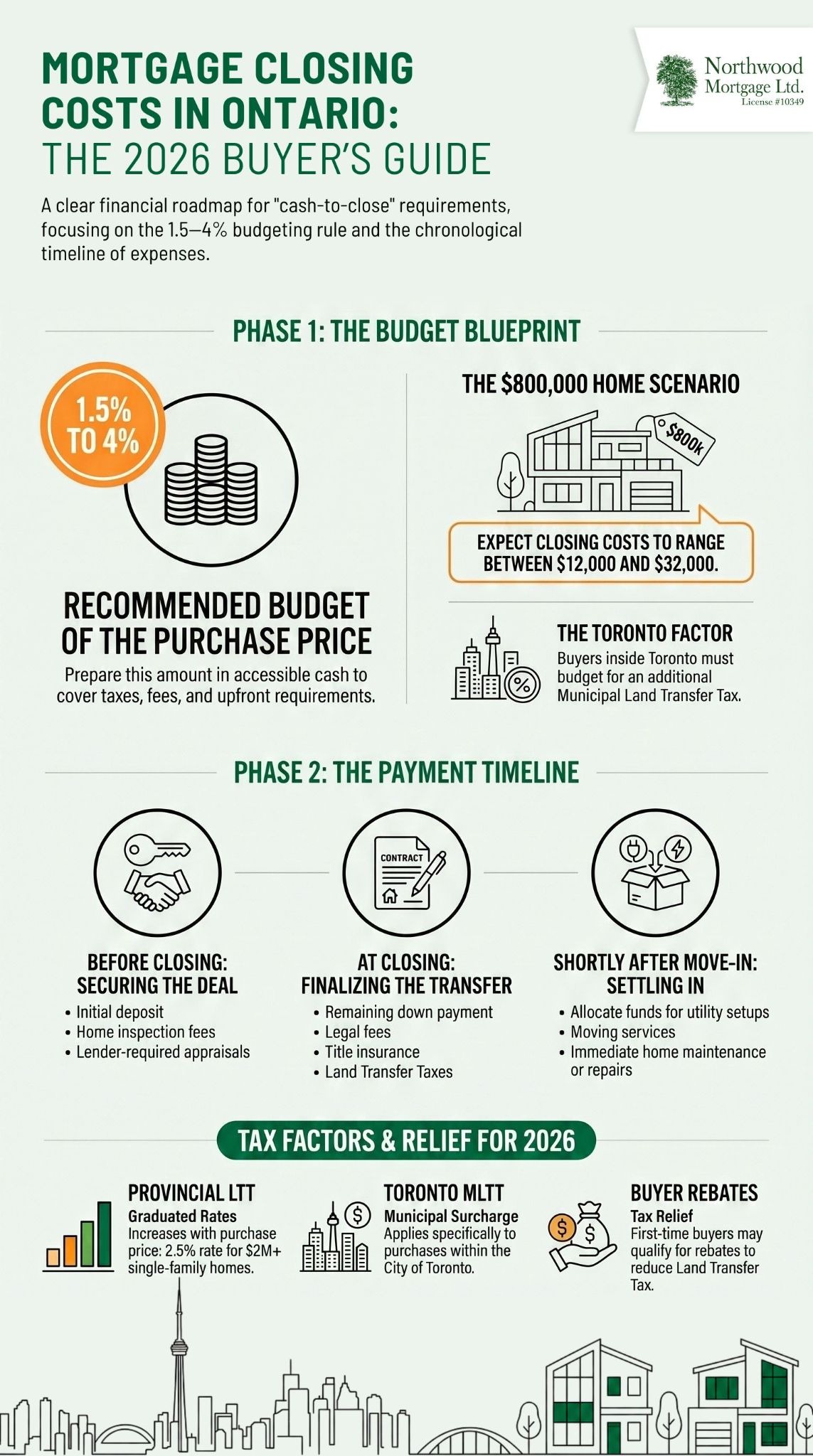
| When It May Come Up | Examples | Why It Matters |
|---|---|---|
| Before closing | Deposit, home inspection, appraisal, condo status certificate review, early legal document review | These costs are paid before mortgage funds are advanced, so buyers need accessible cash early in the process. |
| At closing | Remaining down payment, legal fees, title insurance, land transfer tax, registration costs, mortgage registration, prepaid tax or condo fee adjustments | These costs are usually handled through the buyer’s lawyer and are due close to the closing date. |
| Shortly after move-in | Utility setup, moving costs, locksmiths, small repairs, appliance issues, furniture, window coverings, basic maintenance | These are not legal closing costs, but they affect the same cash reserve buyers need for the first weeks of ownership. |
Mortgage pre-approval should include a cash-to-close discussion, not only a maximum mortgage amount. Before making an offer, first-time buyers should ask:
Northwood Mortgage works with home buyers across Ontario to compare mortgage options, review affordability, discuss lender requirements, and prepare for upfront purchase costs before closing day arrives.
This support is especially helpful when buyers are estimating appraisal needs, deciding how much cash to keep outside the down payment, or comparing the practical costs of buying inside versus outside Toronto.
Treating closing costs as part of your mortgage plan helps avoid financial surprises. A practical estimate should show what is due with the offer, what the lawyer will collect at closing, and what buyers should keep available after moving in.
At Northwood Mortgage, we help Ontario buyers connect that cash-to-close estimate with the mortgage decision itself. Through residential mortgage and pre-approval support, our team can review affordability, compare options from more than 100 lenders, and flag lender requirements such as appraisals before timing gets tight. This can be especially helpful for first-time buyers, Toronto buyers planning for municipal land transfer tax, and borrowers who need a more flexible review of their financial profile.
Before making an offer, speak with one of our Mortgage Agents at Northwood Mortgage about your mortgage options and closing cost plan.



































Wait! Don't Leave without speaking to one of our mortgage experts today!
Call us at 1-416-969-8130